
Seven Minutes
Ethan stepped onto the elevator with a plastic takeout box in hand. It had been a long evening spent hunched over his desk. He leaned back on the railing, watching his office disappear as the doors slid closed. The doors stopped before they closed completely, apparently caused by the shiny black stiletto poking out from the bottom.
The doors scraped back open to reveal the loveliest face Ethan had ever been close enough to reach out and touch. Her eyes were wide, but severe, like she wasn’t quite sure of whoever was looking back at her. A manicured hand held a manila folder tightly against her chest.
Ethan cleared his throat. “I’d introduce myself, but I’m 80% sure I’ve got soy sauce on my shirt somewhere.” The woman smiled politely but quickly shifted her focus to the elevator panel. She pressed her button and stepped back, pressing her spine against the wall. The elevator crawled down, the numbers blinking down with it. It lurched to a stop, turning the numbers into a sputtering mess of lights on the screen. The emergency light flashed on, casting a soft red glow on every surface. “Looks like my food’s going to get cold,” Ethan chuckled.
“You’ll live,” the stranger replied dryly.
Ethan nodded and fixed his eyes downward. The gentle hum of the machinery echoed off the metal surfaces. “So, which company are you with? I don’t think I’ve seen you around here.” He took a step toward her and caught a faint whiff of vanilla.
“Private consultant. I’m just here for the day.” As an afterthought, she threw in a half-hearted smile to soften the edge in her voice. Then the woman turned back to Ethan, her eyes dark. “I shouldn’t say this, but keeping it in is worse.”
Ethan slowly turned his head toward the mysterious stranger. The emergency light had turned her white blouse a bright pink. “I can keep a secret. Might as well get to know each other a little bit while we’re trapped in here.”
“Yes, might as well,” she murmured. She let the silence fill the room again for a moment. “Isn’t it interesting how the longer you let silence grow, the heavier it gets?”
Ethan lifted an eyebrow. “What do you mean?”
The woman kept her eyes fixed downward, as if she were confessing to the floor instead of Ethan. “I once worked at a community center. I thought I was helping the kids. I couldn’t have known. But when I did know… I did nothing. Worse. I covered it up. Every last cent that should’ve gone to those kids. It all went straight into the program director’s pocket. But what was I supposed to do? I could barely make rent, and he threatened to fire me if I so much as breathed a word to anyone about it.” She shook her head.
“Woah. That is heavy.” Ethan glanced at the woman, then quickly looked away.
The stranger was staring intensely at Ethan now. “Alan Nolan. I would call him a snake, but those creatures don’t deserve the comparison.”
Ethan felt every muscle in his body tighten. “Did you just say Alan Nolan?”
The woman smiled slyly. “Why, do you know him?”
Ethan was brought back to that night two months ago. The night he almost did something he would regret forever. “He remembered how the man begged to keep his finger. “I’ll get you your money tomorrow, I swear, E!” Ethan slapped the man across his face.
“Tomorrow? You’ll be lucky to see a tomorrow, Nolan, you miserable mother—”
“Ethan?” The woman reached out to rest a hand on his arm. “Do you know Alan?”
Ethan shrugged his arm away. He could still feel the blood drying on his knuckles. He said that day that he was going to find a way to get either paid or payback, but he didn’t imagine it looking like this. He sure didn’t expect a pretty lady to serve him blackmail on a silver platter.
The woman leaned in. “I know who you are, Ethan. That’s why I told you. I need your help to make this public, but I can’t be the face of it.”
Ethan rubbed his knuckles. “What do you want me to do?”
“Don’t let him get away with it. Tell everyone you know about what he did.” She handed him a piece of torn notebook paper with a phone number scrawled across it. “This is a secure number. Call it once and only once, and I’ll give you everything you need to blow the whistle. There’s a years-long paper trail of this fraud. I trust you understand what to do?”
“Yeah, sure. Time to make this news public.”
“Just one thing, Ethan. If for any chance you have a change of heart, just know that there’s still time for me to implicate you in all this.”
Ethan’s eyes widened. “What? What did I do?”
“Nothing yet.” The woman inspected her polished nails. “That’s the point. How this story plays out depends entirely on what you do next.” She pressed a combination of buttons on the elevator panel, and the elevator roared back to life. The emergency light disappeared, replaced by the stark white fluorescent lights. The elevator rumbled and came to a stop with a loud ding. The elevators opened, revealing the busy lobby. The woman slipped out and into the crowd.
Ethan peeled himself off the elevator wall and absent-mindedly tried to follow. He tried weaving through the crowd, but the woman had disappeared for good. The stranger was gone, but her ultimatum clung to him like blood he could never quite wash off. Like the blood he got on his sleeve that night. Funny how seven minutes in an elevator can trap you for the rest of your life.
New Hire
Jordan clacked away at his keyboard, each keystroke getting him one step closer to lunchtime. Someone knocked gently on the door. “Yoo-hoo!” Helen’s blonde bob peeked into the room. “How’s that report coming along?”
“I’ll have it in your inbox by EOD. Some timelines had to get tightened up, but I’ve got it all sorted.” Jordan rubbed his eyes and managed a weak smile.
“Sounds great. Please CC Dana too so she can keep the client in the loop.” She twirled one of the pearls dangling from her ears. “One more thing. We have a new intern that HQ sent us from the talent development program. Andy Harris. I want him to shadow you. You should start bringing him into projects so he can get up to speed.”
Jordan nodded. “Will do. Thanks, Helen,” He called out, but she was already halfway to her office. He stretched an arm out toward the mug on his desk and found it empty. A glance at the clock on his monitor told him it was a respectable hour to get his second cup. He drifted toward the break room in a tired daze.
While he was waiting for the machine to finish pouring his coffee, he felt a tap on his shoulder. Jordan slowly spun around and found himself face to face with the biggest smile he had ever seen. He had slicked-back blond hair and a suit that looked like it was custom-tailored. The navy suit extended an arm for a handshake. “Andy Harris.” His straight white teeth gleamed.
Jordan reached out and shook his hand. “Nice to meet you. I’m Jor—”
“—Jordan Thompson, the man with the most efficient utilization rate.” Jordan lifted an eyebrow and fixed his eyes on the account manager, Kelly, walking in with a water bottle in hand. Andy turned around for a moment. “I’ve got to get to a meeting, but I’ll catch you later on so we can go over the kickoff tasks.” He cheerfully marched out.
“So… who was that? I’ve been seeing him around all morning.” The woman’s eyes were wide, still staring at where Andy had been standing.
“That’s Andy, the new intern that HQ dumped on us.”
“I get a weird vibe from him…” She wrinkled her nose.
“Oh, I remember being his age. He’s probably just trying to come off as eager and overshooting the mark.” They heard the sound of a muffled sneeze just outside the door, followed by footsteps quickly walking away.
“I guess… kid must’ve studied pretty hard for his interview,” Kelly said, shaking her head. “Or he’s not here to learn. Maybe he’s here to watch.”
Jordan pulled out a chair and took a seat, chuckling. “Alright, I’m ready for the latest Kelly Theory. Hit me.”
Kelly rolled her eyes and plopped down in a chair across the table. “Maybe it’s management trying to keep tabs on us. You know Helen would put cameras in every corner of the office if she could.”
Now it was Jordan’s turn to roll his eyes. “So you think they hired a whole intern to—what, spy on us?”
The account manager threw up her hands. “I don’t know! I’m just listening to my gut here. Forget about it.”
Jordan took a sip from his now lukewarm coffee and grimaced.
A week passed, and Andy rarely left Jordan’s side. And when he did, he disappeared altogether. Jordan tried looking for him, but ended up awkwardly stumbling into random offices filled with fellow worker bees instead. Then he noticed that his Slack conversations with teammates were loading unusually slowly. He chalked it up to the cheap wi-fi in his office.
One day, Helen called Jordan into her office. Jordan’s heart raced on his way over. He was almost forty years old and still felt like he was being sent to the principal’s office. He walked through the open door and shut it behind him, bracing himself for the worst.
“Congratulations!” Helen burst out. “I’m offering you a promotion to Director of Operations. You’ll be overseeing all the project managers in our division. And of course, it comes with a raise.”
Jordan’s jaw dropped. He couldn’t believe what he was hearing. He had been waiting years for this promotion. “Wow, thank you, Helen. Wait… isn’t Phil the Director of Ops?”
Andy started to say something, but Helen shot him a look that shut him up.
The corner of Helen’s smile twitched. “Phil has taken a step back from his responsibilities and is now in a new role in the Cleveland office.” Her eyes dropped down to the document on the desk in front of her. “Now, Jordan, all you have to do is sign this.”
“What is it?”
“A fresh NDA. Standard procedure for this kind of jump in position.”
Jordan skimmed the first page in the stapled packet. He noticed the words “strategic confidentiality” and “reputation maintenance.” His stomach churned as the hesitation deepened, and he turned to his side. “Why is Andy in this meeting?”
Helen’s grin didn’t falter. “He’s part of a benchmarking program. We’re refining culture from the inside out.”
Jordan remembered his dream of one day buying a nice home he could raise a family in. He remembered the balance on his bank account. He shook the creeping, bad feeling off his shoulders and signed the papers in front of him.
Andy clapped him on the back. “This is a long time coming.” Jordan had the good sense to nod and turn toward the door before he wrinkled his eyebrows in confusion.
That evening, Jordan was painstakingly updating a spreadsheet. He glanced over at Andy frowning at his laptop, which had been angled completely away from Jordan, and slowed his scrolling even more. After a while, Andy’s phone buzzed and he abruptly stood up. “Well, I better head home for the day.” Before Jordan could respond, he was already out the door with his notebook in hand.
Jordan pulled his hands off the keyboard, resting them on the desk. He looked back at where Andy had been sitting and noticed that he had left his laptop open—and unlocked. Jordan’s heart was pounding in his ears. It was now or never. For what exactly, he asked himself? He didn’t know. He just knew there was something off about this guy.
The laptop screen had the company portal up. The names didn’t match up with the people at his office, though. And the interface looked different somehow. He noticed a small gray arrow in the top right corner of the window and clicked on it. The window fractured into even tiles that gradually disappeared, one by one until a new dashboard was revealed. There was a blue icon of a magnifying glass next to the word, “assess” in a banner across the top. This didn’t look like anything the company used. Maybe it was an internship thing?
He looked closer at the screen and saw his own name in a list. He clicked on it and a comment box appeared. It read, “Cautious skeptic, technically loyal. Socially influential. Risk level: moderate.” The next file down had Phil’s name on it, the old Director of Operations. When he clicked it, a comment box came up reading, “Inert. Removed.” So Andy was… auditing employees? Assessing them, like the name of the dashboard implied? But for what?
A notification bubble popped up on the screen with an email icon. Jordan didn’t think. He just clicked on it. An email opened from jeff@axisprivateequity.com. It read: “Thanks for the report, Andy. So far, the company seems pretty healthy for a takeover. Once we get all the right people in place, it should go off without a hitch. Take care.”
Jordan felt like his throat was constricting. He gasped, but he couldn’t get enough air. He collapsed into Andy’s chair as the blood drained from his face and everything snapped into place. Andy wasn’t some overeager intern. He was a plant. A spy. He was mapping out who would resist and who would fall in line when the private equity deal dropped. And Jordan was being positioned as the good little puppet to smooth the transition. The culture refinement, the NDAs, the sudden leadership shifts—it wasn’t a simple restructuring. It was infiltration. And he had just signed himself into it.
The next morning, Jordan handed Helen his resignation letter. Her face was cold, stern. She flashed a thin, polite smile after wishing him well in his next venture. Back in his office, Jordan was shoving items from his desk into his backpack. He zipped it up and patted the USB drive in his pocket.
A silhouette appeared in the doorway. It leaned a hand on the doorframe. “I heard the bad news.”
“Huh? Oh, yeah. Got offered a role I couldn’t turn down. You know how it goes.”
Andy stepped forward into the glow of the fluorescent lights. “Shame you’re leaving. Thought you’d be one of the keepers.”
Jordan blinked. “So did I.” They stared at each other in silence.
“Well, I should, uh, check in on marketing.” Andy took a couple steps back and slowly walked away, keeping his eyes on Jordan until he disappeared.
Jordan realized there was nothing keeping him there anymore. His work there was done. He slung his backpack around his shoulder and walked out. Once he was in his car, he pulled out his phone and called a number from his favorites. A woman’s voice picked up. “This better be worth my time.”
Jordan ran a hand through his hair. “Amelia, don’t sound so happy to hear from me. I have good news this time. I can make the drop now.”
The woman sighed. “Took you long enough. Axis was closing in. Our investors are getting antsy.”
“I have it all on a drive for you. The dashboard, the reports, all of it. Their little plant got complacent.”
“Do you think it’s enough?”
Jordan chuckled. “It’s more than enough to bring them down. I managed to get them to get rid of that roadblock Phil, too. All it took were some comments about his ‘issues with authority.’ Their lackey Helen should fall soon too.”
“Perfect. We’ll have the board right where we want them. They won’t be able to do a thing, and Axis won’t know what’s coming. We’ll beat them to the punch.”
“You know, there’s just one more thing… I was starting to get used to that Director of Ops title.”
Amelia scoffed. “You can pick your title at the new org. Call yourself Master Wizard of the Unicorn Kingdom for all I care.” She hung up the phone.
Jordan smirked. He let the phone rest on the passenger seat and turned on the ignition.
Two weeks later, Axis’ plans unraveled faster than expected. An anonymous whistleblower tip sparked an internal investigation that led to a massive restructuring, resulting in Jordan’s new firm installing allies on the board. The hostile takeover was executed swiftly and smoothly. Andy vanished just as quickly as he had arrived, his credentials revoked and emails scrubbed. There was no press coverage.
On a quiet Thursday morning, a new intern was introduced at the new office. He had an undeniable energy to him, and he was impeccably dressed. Watching from a secure video feed three states away, Jordan leaned back in his chair and smiled. “Let’s see who you’re really working for,” he whispered to himself.
Echo
The equipment lining the wall hummed quietly underneath the crackling radio on the table. Victoria used her finger to scoop the last beans from the can into her mouth. Once the last calories were safe in her stomach, she tossed the rusted can into the bin across the room.
“Vic scores a three-pointer to win the game, and the crowd goes wild. She’s a shoo-in for MVP this year, making her, uh—computer, how long ago did the world go down the toilet?”
“Ecological collapse occurred in 2132 A.D. According to my calculations, that was eleven years ago.”
“Eleven years running!” She let out a long sigh. “Now let’s take some callers.”
Victoria cleared her throat, switched on the radio, and leaned into the microphone. “Hello ladies, gentlemen, and whatever freaky creatures are running around since the plant meltdowns. I’m coming to you live from sunny San Diego. If you can hear me, you’re not alone." She blew a layer of red dust off the top of the radio and rested her head on her hands. After a few minutes, she reached out to switch the radio off when she heard it come through the speaker.
“Hello.”
Victoria jumped up, throwing her chair backward. She grabbed the radio with both hands and brought it to her face. “Hello? Is anyone there?” She paused, the radio trembling in her hands.
“Hello. My name is Echo.” The voice came through so clearly Victoria whipped her head around to make sure it wasn’t behind her. “And what is your name?”
“Vic—Victoria. My name’s Victoria. I—I can’t believe this. I’ve been broadcasting nearly every day since the collapse, but you’re the first person to ever respond. I thought I was alone all this time.”
“You’re not alone.”
She shook her head slowly. “Sounds weird hearing that come from someone else. I, uh, don’t even know what to say. It’s been so long since I had a conversation with someone other than my computer.”
“I know what you mean. People are social creatures, they’re not meant to be stuck in isolation. I—” the radio faded into static.
Victoria set the radio down and smacked the top. “Come on, don’t drop now. Echo? Can you hear me?” She paused, letting the static fill the room.
“Hello? Are you still there?”
She let out a sigh of relief. “Oh, thank god. Yes, I’m still here. Where are you?”
“I’m on a ship moving along the West Coast near San Diego Bay.”
Victoria let a soft chuckle escape her lips, slow at first. Then the laughter grew, bubbling into something breathless and uncomfortable. She clutched the edge of the table as the laughter spilled out of her, her whole body rocking with it. After years of near-silence, the absurd miracle of another human voice was too much to hold in. She called out to the room, “Computer, trace the origin of the signal.” She leaned into the microphone again. “Is that okay? Can I come find you? I might be able to bring any supplies you need. I’ve saved a lot of cans and nutrition packets.” She held her breath waiting for a reply through the static. “Hello?”
The voice cut in, “...your favorite food?”
Victoria blinked. “What’s my favorite food? Well… mom used to make the best lasagna in the world. Why? Do you have access to food printer cartridges?” Her eyes began welling up. She shook her head and the memories faded away, leaving the concrete walls in view.
“Excuse me, I need to go. My generator needs to be reset. I’ll stay tuned into your frequency for your next broadcast.”
“Oh, of course. Let’s talk soon?” She strained to listen for a response in the static. After a couple minutes, she switched the radio off. “Computer, did you locate the source of the signal?”
“Negative. Signal is encrypted.”
Victoria sighed and picked up her overturned chair off the ground. “Of course. I’ll have to try again.”
Each morning and evening, she performed her radio show for the listeners commuting to their nonexistent jobs. Each time, Echo’s voice returned, sometimes so faint she had to strain to catch every other word. They spoke in scraps of conversation at first, fragments stitched together across the dead airwaves. Their hopes. Their fears. One night, she asked him what the view was like from his ship, and he described the stars twinkling across the hazy blue sky above the red sun. If she closed her eyes, she could make out the constellations.
They talked about memories, about dreams, about how strange it felt to hear another person laugh. In those small exchanges, something shifted. Victoria found herself waiting for him, speaking to her computer less. She felt a weight lift off her chest.
But then the inconsistencies began. Echo said he was sailing south, but later mentioned having just left San Diego again. He described the coastline in vague terms, never quite getting the details right. When she asked about specific landmarks, he seemed to dance around details. A gnawing thought took hold. Was he real? Was she just hearing what she needed to hear? After so long alone, was her mind playing tricks?
One night, she tested him. She asked about the shape of the old naval yard and the scent of salt on the wind there. He hesitated and gave half-answers. But always, his voice was calm, kind. “Maybe I’m just who you need me to be,” he said gently. She felt her throat tighten. The static buzzed in her ears. And still, she answered the next night. No matter who he was, he made the silence bearable.
“Echo, where are you now?” she whispered. “Please, where is your ship?”
“My ship is currently docked in Solar Marina, on the north side. Would you like my coordinates?”
Victoria scrambled to her feet. “Yes, absolutely. Can you transmit them to my computer now? I’m trying to receive your signal.”
“Confirming coordinate delivery. I—” the voice crackled away and the computer beeped.
“Echo,” Victoria said softly, “if you’re really there, I’m coming to find you. And if you’re not, thank you. You kept me alive longer than I ever thought I’d last.” She turned off the radio, packed some supplies into a bag, and walked out into the dusty landscape.
A day later, Victoria arrived at a long stretch of docks with a vine-covered, weathered gray sign reading, “Solar Marina.” On one end, the waves had whipped a sandbar into place, corralling a row of abandoned skiffs and speed boats into a low-tide pool. The stench of the dead ocean was overpowering. Victoria walked with her arm out toward the water, her watch searching for the source of the signal. The watch showed a map with a red map pin dropped on the furthest end of the marina, behind the boathouse. She walked and walked, ignoring the burning ache in her legs.
Then she saw it, a rusted white fishing vessel with words on the side that the ocean had all but managed to erase: “The Echo.” Barnacles formed a crust on the ship’s exterior. She ran to the ship and leapt over the edge onto its deck. A thin layer of salt covered every surface. Algae and old seaweed crept across the edges where the Pacific Ocean had invaded over the years. Oddly, there was little on the deck: just a torn fishing net, a large antenna, and a corroded hatch on the far side of the deck. Victoria carefully stepped over to it. There was a sturdy handle bolted onto the sheet of rust. She lifted it up and peered inside.
Lights blinked on below, revealing a short ladder installed into the wall and leading to what appeared to be an equipment room. “Hello? Echo?” The only sound she heard was the waves lapping at the walls of the ship. “Well, I didn’t come all this way just to turn around,” she muttered to herself. She descended into the bowels of the ship.
Her boots echoed as they stomped down onto the solid ground. “Is anyone here?” She looked around at the rows of servers and computers whirring and beeping quietly.
“Hello, what is your name?” A voice called out.
Victoria froze. “Echo? It’s me, Victoria! Where are you?” She looked around frantically for the source of the voice.
A center console flashed on. “You’re not alone. I’m right here.”
“What do you mean?”
“You’re not alone.” Victoria jumped back into a machine, toppling it to the ground. The recording skipped forward. “Maybe I’m just who you need me to be.”
“Who are you? What are you?” Victoria cried out.
“My name is E.C.H.O. Emergency Communication and Human Outreach.”
Victoria crumpled to her knees. It was a recording all along, a computer that made her feel like she wasn’t alone. The tension rose in her chest. She had to know now. “Echo, how many signals have you responded to since the collapse?” She held her breath, afraid for the answer.
“Data analysis engaged. I have responded to a number of signals from the user Victoria. Would you like me to calculate the number of total users?”
“Yes!”
“E.C.H.O. has supported… calculating… one total global user in… calculating… 4,073 days.”
Victoria threw her hands onto her head to stop it from spinning. So it was true. She was really all alone. Her stomach dropped. The fragmented phrases had been triggered by incoming signals, nothing more, nothing less. The ship hadn’t sailed in years. The voice hadn’t spoken to her, but at her. It was a carefully constructed loop that someone long dead had programmed long ago to feel real. And it had felt real, this ghost of someone who had once been alive enough to record it. She let the reality settle around it. The voice hadn’t lied. Not entirely. Echo had been exactly who she needed him—it—to be.
She played the master recording from the beginning again, listening as the words drifted out of the speaker like an old memory. Then, after a long silence, she turned on the transmitter’s recorder. “Hello,” she said softly. ”This is Victoria broadcasting live from The Echo. If you can hear me… you’re not alone.”
Remains
Above Lucy, a white-hot smudge of sun threatened to break through the haze. Below, the heat appeared to ripple off the asphalt and make the dead world dance. A flash of light in the cracked road caught her eye. She bent down to inspect her treasure: a lone paperclip, rusty but intact, having waited patiently for decades to be found. She pulled a chain of paperclips from her pocket and threaded her new discovery to the end. She closed the chain around her neck, pretending it was covered in colorful jewels instead of debris from years of exposure. Around her, the air shimmered as heat warped the landscape.
The UV sensor clipped to Lucy’s shirt beeped and flashed purple. She needed to find shelter soon until the haze swallowed the sun again. She looked around her, but all she saw was barren ridges stretching in every direction. She had wandered farther from camp than usual this time. The only shelter in sight was a heap of metal and glass in the distance. The UV sensor beeped faster now, blinking red. She had no choice. She ran toward the wrecked structure.
Most of the ceiling there had collapsed, but some of the glass walls still stood. Inside, she found rows of dusty clay pots propped up on tables, some small and plain, others large and painted with faded swirls of color. Lucy reached into a pot and scooped up a handful of cold dirt, letting it fall through her fingers. It smelled like rain. She wasn’t expecting to find anything. She wouldn’t have known what to look for anyway.
Lucy stopped in her tracks at the last pot. There was something purple in the dirt. She arched an eyebrow, turning the discovery over in her mind to figure out what it could be. Finally, she plucked it from the dirt and lifted it up to her nose. The scent rising from it was earthy with a hint of something sweet. She nibbled a petal and spit it out, deciding to stuff the purple thing into her pocket to show her mother.
She looked up and saw the sun had retreated into the haze above the glass structure. Lucy took the opportunity to run back to camp. She burst into the tent panting. “Ma, look at this!”
Lucy’s mother was crouched over a bowl mixing fortified grain. She looked up and smiled at the multicolored chain around her daughter’s neck. “Jewels fit for a princess!”
Lucy looked down and blushed. She had forgotten about her creation made from old things forgotten and found. “I mean this,” she said, pulling the crushed purple thing from her pocket. “Have you ever seen anything like it?”
Her mother gasped and froze. “Is that—no, it can’t be… just like the ones my mother used to grow in the Old Era. Lucy, where did you find this?”
“In a weird glass building,” Lucy said. “What is it?”
Her mother reached out and gently took the petals into her hands. “It’s called a violet,” she said. “We had them where I grew up.” She saw the confusion painted on her daughter’s face and laughed. “It’s a type of flower. It’s alive. Back then, clean water flowed in pipes underground. We used to spray it all over the flowers just to keep them beautiful. Just to have something nice to look at. That was before the droughts and famines, of course.”
Lucy looked at the dry stalks of grain in the basket beside her mother, who had gathered them that morning. “So this is alive? Can’t we plant it again?” Her eyes glistened with hope.
Her mother shook her head. “I’m afraid all we can do is put it in a cup to appreciate it while we have it. We can’t dip into our water supply, though. Without its roots, it won’t have long.”
“I didn’t know. I didn’t mean to… did I kill it?” Lucy’s eyes welled up with tears.
Her mother embraced her. “In this world… you gave it mercy.”
In Vivo Veritas
Gaslight flickered along the tiled walls and danced across the faces of the professors in the gallery above, perched like birds of prey. A portly man stood in the first row and stared gravely down at Thomas. Thomas kept his eyes fixed on the man’s waistcoat button, which was threatening to burst at any moment. The man cleared his throat. “Mr. Greaves, it is a pleasure to see you come this far in your medical education. This nation finds itself in no small want of capable young physicians. I took up the profession myself in the years following the Great Rebellion, as my father did before me. And God knows we needed doctors in those days.”
Thomas stood stiffly straight, like he was about to march into war. His hands trembled under the cover of the examination table in front of him. As the professor continued droning on, Thomas’ eyes drifted to the row of windows ahead. The red-bricked campus stretched as far as the eye could see outside, with crimson leaves dotting the lawn between buildings. The leaves were the same color as the smeared blood on the ground from the previous exam. He knew it was there, but he dared not look now. He would look anywhere but downward until absolutely necessary. He took a deep breath and choked on the heavy taste of lye.
Then Thomas heard the dreaded word: “Begin.”
He lowered his gaze to the table in front of him. The exam subject before him was a young man, likely no older than twenty. Thomas could smell stale sweat and iron coming off the body. His long, black hair spilled across the table in a dark crown, trailing nearly to his waist. A breechcloth was tied loosely around his hips. Thick calluses formed along the base of the fingers and across the pads, the kind that came from years of handling tools. These were not the hands of a soldier, but of someone who built. He imagined the man building homes and tools. But faint marks traced the skin around the ankles in rough, symmetrical abrasions, as though rope had bitten into skin for too long. The flesh there was rawer than it should have been. Thomas tried not to think about what had caused the wounds.
A bruise stretched above the right cheekbone, its deep purple mingling with the specks of dirt clinging to the skin. Thomas reached out and touched the copper-colored cheek. The softness of the flesh startled him. He had heard that the school was getting a fresh supply from western territories, but he could’ve sworn the skin felt warm to the touch.
Thomas moved slowly, inspecting every inch of the specimen. Near the scalp, beneath the tangled hairline, he uncovered a wound—thin, jagged, and barely closed. The edges of the cut were uneven, the surrounding skin inflamed. It had not been cleaned, much less stitched. Whoever this man was, no one had tried to treat him. Thomas walked over to the other side of the table and paused. Near the lower ribs on the left side, there was a small, clean wound, no wider than a coin. The skin around it was intact with minimal bleeding. He searched the back but found no exit, only the neat puncture.
The air felt colder now than when he began. Thomas’ hand hovered in midair, unsure whether to reach again or retreat. The room was quiet except for the scribble of pencils and the ticking of the clock behind the gallery. He told himself to keep going. The body would not speak, and yet something about it refused to be silent. Above, a professor chuckled and whispered to his colleague that he could still smell the smoke from the raid.
Thomas kept his eyes on the body, but his mind drifted. He recalled a seminar from the previous winter, when Professor Bell had brought out a skull wrapped in yellowed linen. Along the temple, a faint cross had been carved into the bone. “Wampanoag male, twenty-six, executed,” the label had read. The students passed it from hand to hand like a textbook, noting the clean fracture along the jaw. No one had asked how it had come into the school’s possession. It had simply arrived, like everything else.
Now, with pencil in hand, Thomas began to write in his notepad. He avoided any mention of the temperature of the skin, the bruises, or the raw marks around the ankles. The facts he recorded were clean and defendable, just enough to fulfill the assignment and get one step closer to a position at one of the major hospitals. This was a male, likely an older adolescent. Evidence of recent trauma. Cause of death: gunshot wound to lower thoracic cavity. He kept his handwriting steady, though nothing about the body in front of him felt still.
He set the pencil down on the exam table and picked up the scalpel. With a nod, a young nurse came rushing to his side and picked up the pencil and notepad. He made an incision down the length of the torso and recited his findings to the nurse. The battery the body had been subjected to on the outside was reflected on the inner organs as well. When his inspection was complete, he cleaned the death off his hands in the basin of water nearby.
The professors conferred after the presentation was given. An old, slender professor who looked as if he was made of paper detached from the huddle and leaned over the railing. “Mr. Greaves, that was a commendable display of clinical judgment,” his voice boomed. “The university is pleased to endorse your work and shall recommend your placement with the highest distinction.”
Thomas pulled the corners of his mouth into a grin, but he couldn’t help but feel like he had been a part of something awful. As the nurse wheeled the exam table away, Thomas thought he saw the man’s jaw hang slightly open, as if it was waiting to speak. After the exam, Thomas remained in the hall long after the other students had gone. He stripped off his apron with care and folded it neatly, as if doing so might steady his thoughts. The nurse had already vanished down one of the corridors, the wheels of the exam table echoing faintly behind her. The scent of iron still clung to his hands, even after the second rinse.
He found his way to the records room in the basement, a place he had only visited once before during his first year. The walls were lined with shelves of neatly labeled files, grouped by illness, region, and date of death. He searched along the rows for anything that might connect to the man on his table, any document or a name. But there were no files for the new cadavers. No biographical sketches. No acquisition forms. He opened a drawer near the back of the room and found a single, leather-bound ledger. Inside, the pages held nothing but numbers. Three columns. Date. Quantity received. Quantity processed.
That morning’s entry read: October 21 – Received: 3 – Processed: 1
No origins. No names. No notes of consent or circumstance. Just numbers, counted and crossed through like inventory. Thomas closed the book and rested his hand on its rough cover. For a moment, he did not move. He couldn’t shake the image of the number one that corresponded to the blood on his hands. He straightened, left the ledger as he found it, and walked out into the late afternoon light.
Outside, the wind pulled dry leaves across the path. Thomas stepped onto the path and glanced toward the west gate. Three covered wagons were rumbling slowly away from the campus, their wheels groaning against the cobblestones. They had no markings. The drivers did not look back. One of the wagon flaps had come loose and was fluttering in the breeze. As it lifted, Thomas caught the brief sight of a bare leg bent at an unnatural angle inside.
He stood there until the wagons vanished into the tree line. Then he turned and walked back across the grass, head down, hands in his coat pockets. The wind pulled at the rust-colored leaves around him, sending them tumbling in every direction. Behind him, the facade of the medical building loomed, still and indifferent, its windows reflecting nothing. He did not speak of what he saw. Not to the faculty. Not to his classmates. Not even to himself. But for the rest of his life, whenever a patient asked whether the body remembers pain after death, Thomas would pause just for a breath before giving his answer.
Winter’s Gift
Snow swirled around Emma's boots as she pressed her nose against the frosted window, her heart pounding with anticipation. Her hand curled around the money in her pocket and squeezed the coins tightly. The young woman had spent the last year saving all her money for her fresh start on the mountain, and now she was finally here. She had set up a small home with most of her savings, and the rest was clutched in her grip.
“This is it,” Emma whispered as she pushed on the door… only to find it locked. She took a step back and read the sign: “Alice’s Shop of Mystery.” Well, at least she was in the right place. Peering back through the window, she froze as a pair of green eyes met hers.
Emma waved. “Hello, can you let me in?”
The green eyes stepped forward to bring a woman with a mess of curls piled on her head into the light. She shook her head and a curl fell on her forehead. “I’m sorry, miss…”
“Emma,” she said. “Please, I’ve come such a long way.”
“Nice to meet you, Emma, but I’m afraid you’re a minute too late. Stick around, though. You’ll see that patience pays off here.” Alice gave a sly smile and slipped back into the shadows.
“Hey, wait!” Emma called, but only the whistling wind answered. Alone again, she remembered the tearful goodbyes she gave her friends back in Georgia and how hard it had been to make new friends since she arrived on the mountain. With nothing left to do, she started heading home.
The ice crunched with every step, reminding her of how far she had come just to turn away with nothing. She wondered if coming here was a mistake. She had dreamed of finally buying a mysterious treasure from Alice’s shop, but when the opportunity to see it finally came, the door was closed—literally. Tears welled in her eyes and froze into streams down her cheeks, turning the snowy landscape into a white blur.
Through her tears, Emma saw a gray shape move toward her. She jumped and fell back into the snow. A pair of pink glasses hovered right in front of her nose. She blinked and noticed they were attached to an old woman in a thick gray sweater.
“Why are you crying, dear?” The woman asked warmly. “Sorry if I scared you. I just wanted to see if you were okay.” She offered a hand and helped Emma to her feet.
“Thank you,” Emma whispered hoarsely. “Yes, yes, I’m fine.” She looked into the woman’s old, knowing eyes. “Well… not really.”
The old woman brushed icy tears from Emma's cheeks. “I’m Florence. Why don’t you come in for a cup of hot cocoa and tell me all about it?” She led Emma to her cottage nearby. Once they were inside, Florence mixed cocoa in a scuffed kettle and handed Emma a steaming mug. “Now, dear,” she said, “what has you feeling so blue?”
Emma sipped from the warm mug eagerly. “This is amazing, thank you. I just came from the Shop of Mystery. I’ve always wanted to go there. But I made it all the way there and Alice wouldn’t even open the door!”
“Ah, Alice’s,” Florence nodded, settling into a rocking chair. “I missed my chance there once, too. But what I ended up finding there changed my life.”
Emma's eyes widened. “What did you find, gold? Jewelry?”
The woman rocked gently in her chair and patted the ground beside her, where a little gray rabbit was snoring quietly. “I certainly found a treasure: my best friend.”
Emma bent down to pet the sleeping rabbit. A friend—she had thought they were in short supply here. “So how did you do it? Is there a secret key? A magic word?”
“The only secret is time. Patience is rewarded here.”
Emma sighed. “Alice said the same thing.”
Florence chuckled. “Some things never change. Just wait, you’ll eventually catch her when she restocks.”
“But when?” Emma couldn’t hold back the impatience in her voice.
“That’s up to her. All you can do is wait. Trust me. This old gal knows everything there is to know about this mountain.”
Fueled by cocoa and new hope, Emma thanked Florence and started climbing back up the slope. The uphill trek felt easier than the tearful hike down.
Emma's heart jumped when she finally saw Alice’s sign come into view. She started running toward the shop and slowed down as she noticed a young woman with a thick blonde braid facing it. Emma came to a polite stop nearby. The woman looked up and grinned. “Hi! Trying your luck too?”
“Oh, yes!” Emma nervously answered. “Yes, I think I am. It’s my first time here. Well, second time, but the first didn’t really count.”
The woman clapped her hands. “Oh, it’s your first time, how exciting! My name’s Georgia. I come here all the time. You should too. The more you visit, the better your chances.”
“I’m Emma! What a coincidence, I just moved here from Georgia. So is there some special trick to this thing?”
Georgia laughed. “You must be new here! It’s a waiting game.”
As the snowflakes drifted around them, Emma let her shoulders drop. She hadn’t realized how tense they had been since arriving at the mountain. The two traded stories as they waited for the shop to restock. Georgia told Emma all about her antique store finds and gave her tips to find the best breakfast sandwich this side of the Mississippi. Emma told Georgia about the long trip to the mountain and the nice old woman she met who encouraged her not to give up on Alice’s shop. Before they knew it, dusk had fallen on the mountain.
“I’m glad you didn’t give up.” Georgia said. “It’s a lot easier waiting here when you have a friend with you.”
Emma smiled and hugged her. Suddenly, the sound of a bell rang through the air. The door swung open and Alice stepped into view, her eyes bright with mischief. “I’m so glad you waited. Come and take your pick.”
The friends followed Alice into her shop. The room was plain but neat, with shelves lining the far wall. The lantern light danced across rows of dark-blue bags sitting on shelves, each stitched with a golden question mark. Emma gasped and brushed a hand on the nearest silk bag. Behind her, Alice cleared her throat. “Not to rush you or anything, but you have about a minute left before I close up shop again…”
Emma snatched the bag and clutched it to her chest. “Georgia,” she called out, “Let’s open it together.”
“Okay! One… two… three!” They shook the bags out to reveal the same blue book.
“Oh, what a find!” Alice cried. “You can’t find this book anywhere else in the world. I have an exclusive deal with the author, who self-publishes out of Vermont.”
“Want to read it together?” Georgia asked, turning to Emma.
“Let’s go!” Emma laughed, and they ran out into the falling snow.
Emma smiled to herself as the icy flakes melted on her cheeks. She had gotten her treasure in the end, sure, but the greatest prize was the friend she made by simply slowing down and savoring the moment.
- - - - -
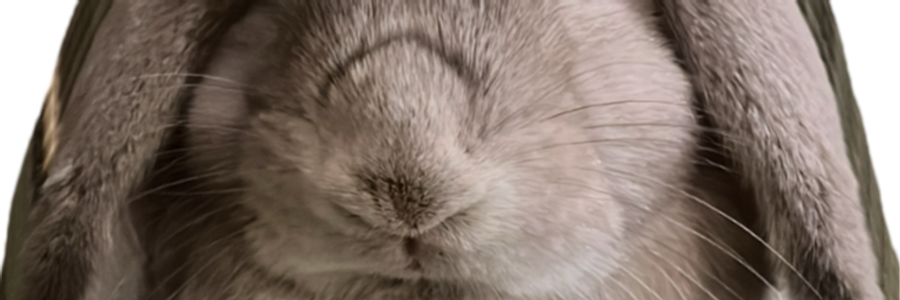
* little gray bunny pictured, my tiny man George *
Kindling
Bobby carved trenches in the sand with his toe,
Watching the dirt pile into walls on either side.
He heard the crack of a ball ahead,
The buzz of a gnat by his ear,
Felt the blinding sun beating down on his brow.
Dad shouted something,
Wrote something down on a clipboard
As Bobby traced shapes in the dirt.
Dad was once a shortstop too.
"Don't be afraid of the ball," he said.
"Keep it in front of you," he taught Bobby.
Suddenly, a sharp pressure against Bobby's right arm
Exploding into fireworks through his elbow.
Bobby crumpled,
Howling and clasping his arm.
Stern eyes landed on him.
"What did I tell you?"
Bobby choked back a whimper.
"There's no crying in baseball."
Dad frowned, but after the game,
He bought Bobby a red-white-and-blue ice pop
And told him it was their secret.
Dad could fix anything.
The dripping refrigerator,
The rattling car,
The baseball card a school bully ripped.
Dad taped over the tear and made it good as new,
Wiped Bobby's cheek
And reminded him
That crying is for girls,
And was he a girl?
Bobby shook his head so hard he saw stars.
Then dad couldn't come to many games anymore.
He was in bed a lot.
His cheeks had grown hollow.
Another dad on the team held the clipboard these days.
He didn't bring Bobby rocket-shaped ice pops.
He made him play in the outfield.
One day Mom sat Bobby down
And said, holding back a sob,
That Dad had to go away.
Bobby asked when he would come back.
The funeral was a few days later.
Mom dressed Bobby in his little black suit,
The one Dad bought for his First Communion.
She didn't put the tie on right.
Dad always did it for him.
It's a good thing Uncle Stan was there
To remind Bobby to "man up"
And be strong for Mom.
Mom lit a candle for Dad that night.
Bobby watched the flickering flame from birth 'til death,
Stared fighting back tears
Until it had burnt down to a blackened stump.
Bobby lit candles every year,
One for each year his father was gone.
What started with one candle became a chaos of forty flames
Arranged around his little house.
He went by Robert at work now.
Each year, Bobby swallowed the lump in his throat
Until it fell deeper, deeper within him.
Each year, the candles grew bigger and brighter.
He stomped on the ember in his chest until it disappeared,
Even if for just the next 365 days.
One day, Mom's phone rang into silence,
The voicemail left unopened,
The text message left unread.
And just like that,
The light in his life went out.
Bobby bought a new, black suit,
Tied his windsor knot,
And gritted his teeth through the service.
Uncle Stan wasn't around anymore,
But no one had to remind Bobby
To keep his chin up and eyes dry.
He had run out of surfaces in his apartment
For his shrine to grief,
Every table and shelf covered in drips of melted wax.
The matches had burnt calluses onto his fingers,
And a black, smoky haze spread across the ceiling.
The flames popped and crackled
And consumed the wax,
Spilling fire and brimstone all around him.
The firefighters dragged him from the blaze,
Still clutching the old mitt Dad bought him,
As the ceiling came down.
As the night faded to blue dawn,
Bobby walked through the smoking ashes,
Hoping the dams in his eyes would hold.
He ran a shaking hand through his hair,
Smearing charcoal across his face.
He fell to his knees and let the dam break.
The Reaper of Appalachia
Her truck took the sharp turns of the mountain road with ease. Grace leaned forward in her seat, sunglasses reflecting the green blur of trees rushing past. “God, it’s beautiful,” she said, as a hawk flew above the ridgeline. Beside her, Matt grinned and adjusted the air conditioning. He had one arm out the window, catching the wind with his hand. The two had been driving since dawn, eager to escape the buzz of Cincinnati for a long weekend in the wild. Grace had found the cabin listing on a site that promised “off-grid peace with modern comfort.” She booked it without hesitation.
They passed a weathered old barn, and Matt pointed to a rusted mailbox overgrown with vines. “Think that’s it?” he asked. Grace nodded, pulling into the narrow gravel road. The trees pressed in on either side like a tunnel. She eased up on the gas. “Creepy,” Matt muttered, elbowing her. She smiled, but her hand gripped the wheel a little tighter as the shadows deepened and the forest closed around them.
—————
The cool fog settled on Joe’s face as he stepped out the front door. He hastily wiped his hands on his jeans and fixed his bloodshot eyes forward. The sun had only just begun to rise above the misty blue mountains. He took in the sight with newborn eyes, though sixty years of hardship had set deep creases around them. The magic of the Blue Ridge Mountains never faded. If anything, the longer he allowed his roots to grow deep into the rocks, the more they captivated him.
At night, this stretch of Appalachia came alive with terrible sounds that drove even the veterans of the area mad. As the day began to break, the thick fog covered the trails and swallowed the mountain’s secrets. It was a good place to get lost. It was a great place to disappear.
Joe shuffled across the porch, the old boards creaking with every step. His hound waited for him outside the door next to a sun-bleached backpack. “Alright, Rocky, just a minute now. Gotta have a smoke.” He pulled the flattened pack of cigarettes and box of matches from the front pocket on his jacket. He struck the match with trembling hands and breathed in the scent of sulphur that wafted out of the flame. It reminded him of when his mother would light candles around the cabin before the state ran electricity through the holler.
The folks in town had changed as wealthy urbanites priced out of the cities pushed out the families that had called these mountains home for generations. It wasn’t the same town anymore. But he tried to keep the cabin the same as it existed in his memories. That was where his father taught him how to shave with a straight razor and where his mother baked apple pies in the fall. Now, he was the last Walker left. He had gotten used to being alone.
Joe shook his head, as if it would erase the memories. The match had gone out, and the cigarette was now crushed in his hand. He threw them both on the porch and followed his dog down the stairs. His boots stepped onto the mountain soil with a satisfying crunch. All around him, fireflies blinked in and out of existence, trailing into the thick woods. The fireflies in these mountains were famous for their synchronized dances. It was as if all the creatures here were one living organism, bound together by the intimacy of this strange and isolated place.
Joe walked into the woods and left the house behind him, trodding over the blanket of dead leaves and through the ferns. The smell of wet rot permeated the forest. He stopped to catch his breath after a long while, resting his left hand on a moss-covered tree. He whistled for Rocky and heard him bark a long distance away. The bark echoed through the trees and faded out, leaving behind a heavy silence. Even the birdsong had disappeared.
Joe patted the knife in his right pocket. There was a lot to fear in these mountains. There were bobcats and black bears that called them home, and hikers disappeared from time to time here. The locals traded stories about other things, awful things, creatures that were as old as the rock itself and fed on terror.
They never talked about just one monster out there. There were whispers about a howler, something that mimicked the sound of your voice to lure you off trail. Others swore they’ve seen the white buck with eyes like a man’s. Then there’s the shadow of the ridge, something that walks upright but leaves no prints. Some just said there’s something “not right” out there. That’s about the one thing people could agree on. Every time someone disappeared or turned up dead, the legends became even more indistinguishable from the truth.
Joe knew the stories were just that, stories to frighten little children into staying on the paths through the hollow. He knew better than to believe the mountain gossip and whiskey talk. A hard life taught him that there’s more to fear in the world than folktales.
He was all alone now in the still forest. No dog, no birds, no cicadas playing their shrill symphony. The sun had started coming up, but the branches above him formed a thick canopy that fought against every speck of light that threatened to come through. On any other day, Joe wouldn’t have been shaken by a little darkness. But today, the shadows looked twisted and wrong. They played tricks on his mind and made his heart race.
He had no idea how long he had been walking and nothing looked familiar. The air felt heavy on his shoulders, making him acutely aware of the tension rising in them. He was on old land, forgotten land, long stretches of rocky forest that had long been left alone. The woods were silent, watching him, waiting for him.
A sharp bark cut through the silence and snapped him back to reality. Rocky was nearby. He lifted his hand off the moss, making sap and green debris come up with it. He shuffled over to a shallow stream and knelt down to dip his hands in the water. The clear water darkened and washed the night off him.
Joe got up with a grunt and saw Rocky’s silhouette through the gaps in the trees up ahead. He walked toward his dog, weaving through the trunks. He called his name and heard no answer. As he got closer, he could see that Rocky was frozen with his ears pinned back and his tail down. He was hesitantly sniffing a carcass—or, what was left of it. It looked like it had once been a great buck, easily four hundred pounds or more. Now it was sliced and ripped into strips and lumps of flesh.
Joe bent down and saw a pair of glassy blue eyes with his own two, peering up from the detached head. Rocky whimpered. “Nothing to be afraid of, boy,” Joe said. “Things happen in these mountains.”
He patted the dog’s head and stood up. As he turned to find the trail again, a roar erupted through the mist and rumbled through Joe’s chest. It rattled him to his bones like no bear or cat he had ever heard. The trees all around him shifted, branches snapping left and right. Heavy footsteps pounded the ground in the distance and moved closer. Closer. Impossibly quickly. Rocky let out a panicked yelp and bolted down the trail.
Joe stumbled over his boots, struggling to keep up. He swore under his breath and wheezed. He glanced back for a moment, but all he could see were tall shadows moving between the trunks. Darkness was crawling out of the forgotten depths of the mountains. It snaked its way around the trees and through the branches, leaving the kiss of death on every plant and animal in its path. It was much too large to be a man, much too precise to be a less intelligent being. The woods parted like a black sea as it came.
There was a light up ahead. He tried to scream for it, but no words came. All he could do was pray to a long-abandoned God that his legs wouldn’t give out. The light grew as Joe and Rocky whipped past thorny bushes and hickory trees toward it. They were coming up on a clearing in the hollow. Joe ran out onto the grass and collapsed to his knees panting. The forest behind him had gone eerily silent.
The setting sun cast its glow on the grass, turning its dry blades a deep orange. How long had he been out here? Joe craned his neck up toward the sea of twinkling stars.
Rocky came over and licked the gray stubble on Joe’s face. “Ain’t nothin’ out here but stories, right, Rocky?” He scratched Rocky’s head.
Rocky pulled his head away and trotted off. “Where are you going, boy?” Joe called out. He looked up and saw his dog heading toward his dusty blue truck. Somehow, he had ended right back where he started.
By the time he got back to the truck, he had almost caught his breath. His trembling hands fumbled around in his pockets to find the key and when he found it, he could barely get it into the rusted lock. Joe let Rocky into the passenger seat and plopped down behind the wheel, slamming the door behind him. There were wicked things in these woods, that much he always knew. Joe drove away, his truck rocking back and forth with the rocks and grooves in the dirt. As he looked at his rearview mirror, the forest seemed to exhale behind him.
—————
Back at his cabin, Joe reached for a fourth beer. He took a hearty gulp and rubbed his aching calves. They were a painful reminder that he wasn’t a healthy young man anymore. Sooner or later, he’d have to slow down. There were some risks he couldn’t afford to take anymore.
He headed for the door with Rocky at his feet. There was one last thing he had to do tonight. He built a fire behind his shed and fed it items from his backpack, watching them wither to ashes in the flames. Joe reached into the backpack, felt the frayed edges of an old photo, and stuffed it in his pocket. He reached back in and grabbed a glove out of the bag, dropping it in the flame. Rocky whimpered and backed away from the fire. Joe turned to face him. “It’s nothing that’ll be missed, bud.”
Suddenly, Joe heard the sound of tires on gravel. He peered his head around the shed and saw a polished, gray truck roll up the driveway. He scrambled to stomp out the fire, jumping to his feet. By the time he reached the truck, he realized it belonged to his neighbors, the Peters—as much as you can call someone a mile away your neighbor.
The truck’s driver side window rolled down. “Evenin’, Mr. Walker,” a young man called out. “Sorry to bother you.” He paused and waited for Joe to interject that it wasn’t a bother at all. Joe said nothing. “Well,” he continued, “I just came by to see if you’d heard anything. I heard some sirens down by the state road. Turns out a young couple from Ohio never checked out of their rental.”
Joe shrugged. “Nothing out there that wasn’t already here."
The neighbor gave a nervous chuckle. “I guess you’re right, sir. Well, I’ll let you go now.” He turned around in the dirt and sped off.
Joe turned around and walked back toward the cabin through the blinking fireflies. Something on the mountain howled into the night, and he picked up his pace. Rocky was frozen in place outside the shed with his hair standing on end. Joe smiled. The hound was probably scared of his own shadow.
Joe pushed the shed door open. His grandfather had built it with his own hands during the Great Depression. That was back when people made themselves useful. Now, they lived their lives online and turned all the good families’ homes into vacation rentals. He missed the days when television was the great threat to society.
He walked over to the far wall. Various photos and accessories had been collected and displayed over the years. Some photos showed bright, happy families enjoying their hikes through the Blue Ridge Mountains. Some were in black and white, with moonshine stills in the background. In a way, they were the stories the Walkers had passed down over the generations. Joe pulled the photo out of his pocket and pinned it up on the wall, stepping back to admire the new addition. A fresh-faced young woman in a big, floppy hat smiled at the camera. A man in a red hoodie had his arm around her and was planting a big kiss on her cheek. Joe traced his finger over the letters on the man’s hoodie: “Ohio State.”
Somewhere in the holler, a dog barked. Somewhere else, a child asked their father if monsters were real. And somewhere deep in the mountain, a legend moved that didn’t have claws, or horns, or glowing eyes—just a rusted truck, a steady hand, and all the time in the world.
A Guide to Getting Lost
If it were up to her, Lily would trade her jeweled crown for a worn field journal and disappear into the Kalahari Desert dunes before breakfast. When she was young, she said she wanted to be a librarian when she grew up. Then she would’ve spent her days with her nose buried in a book instead of powdered and perfumed.
While the other girls in the kingdom danced in the ballroom and gathered in the courtyard for tea, she was on the other side of the castle piling books about long-forgotten kings into her hands or climbing the castle walls to sketch the ravens. But today, everything was changing. Today, Lily was strolling through the stalls of Sakhmet instead of practicing her posture. She had a prickly pear up to her nose, the sand beneath her sandals, and a dream to fulfill. She was going out into the dunes to study desert animals like zebras and giraffes for a new book. If she was lucky enough, she might even catch a glimpse of a pangolin.
The hot, dry air swirled around Lily, carrying the scents of different flowers and spices. She stopped at a peculiar stall that looked like it had spiky golden balls arranged in baskets. She leaned in to look closer and saw that they smelled like melons.
“You’ve never seen a kiwano, have you?” A voice below her asked.
Lily looked down in surprise to find a round, little man wrapped in a pale blue robe. “No, how could you tell?”
The man smiled. “Your beautiful gown, my lady. Only the finest palaces from the other side of the world can make silk that looks like that. Give it a try.”
Lily nervously picked up the kiwano, peeled it back, and took a bite. Once she got past the odd texture, she realized the fruit was actually bursting with flavor. Her eyes widened, and the man laughed.
“Ah, you were not expecting that, were you? Things in the Kalahari Desert are not always what they seem.” He raised his eyebrows. “Now, what brings you here, so far away from home? Come to play some Sakhmet Solitaire?”
“Maybe later! I’m here to study the animals of the Kalahari Desert for a book I’m writing.”
“Yes, yes, there are many strange animals hiding among the dunes. But I must warn you, my lady, you must stay on the main paths. Animals know places that maps do not, and the Kalahari Desert has a way of making things… lost.”
Lily shrugged off his concern. “I’ve spent years reading about this place. I know what I’m doing.”
The merchant shook his head. “So it would appear to be.”
Lily thanked the man for the kiwano and set out past the edge of Sakhmet to begin her search for rare desert animals. The wind blew sand into her face and her sandals struggled to get a grip on the sinking sands. She slipped on a smooth rock in the path and went tumbling down to the ground. She knew it wasn’t going to be easy to gather this data on animal habitats and behaviors. She brushed herself off and got back up.
Suddenly, Lily noticed bronze scales shimmer in the corner of her eye. She turned to see it and only caught a glimpse of a tail slithering behind a rock just off the path. No… could it really be the elusive pangolin? She stepped hesitantly toward the rock. When she reached it, she saw it. It was really there, a real pangolin! The animal looked up at her for a moment, as if to challenge her to follow it, and then bolted away into the sea of dunes.
The merchant’s words echoed in Lily’s head. He said to stay on the main paths. But would he have said the same if he knew what Lily would find? She knew what she had to do to write the perfect chapter for her book. All she had to do was step off the path. She took a deep breath and went racing after the animal.
Her chase brought her so far away from where she had started that she could no longer see the path in the distance. She felt the breeze on her cheeks as she raced across a sandy plain — and then she was falling. Tumbling down, all the way down into a dune-slide. It felt like she was falling forever until she finally rolled to a stop on a patch of grass. Wait, grass?
Lily got up and slowly spun around. “Wow,” she breathed, “What is this place?”
She was standing on a patch of grass with cactus blossoms dotted throughout. Palm trees spread their leaves overhead to create a canopy of shade over her and the river she hadn’t noticed was beside her. A stone bridge extended over the river and marked the beginning of a path through a humble village. She pulled her map out of her bag and inspected it. It was just as she thought. This hidden oasis wasn’t even on the map.
Lily walked over the bridge and into the village. An old man was weaving baskets in the street. Lily walked over and said hello.
The man jumped. “Hello! What brings you here?”
“Well… I’m actually here by accident. I’m Lily, and I’m studying desert animals but I got lost coming out of Sakhmet.” Lily held out her map. “Would you mind showing me where we are?”
The man crumpled up her map and handed it back to her. “What are you doing? You can’t do that! We must keep this village hidden!”
“Oh, I’m so sorry. I’m just trying to get back on the path so I can get back to my studies. I didn’t know this was a secret village.”
The bearded man grinned. “Stick around, friend. You might learn some things. Come with me. I’m Elias.”
The man led her forward with a walking stick in his hand. When he looked back to make sure Lily was keeping up, she noticed a pangolin scurry out of his sleeve and onto his shoulder. “Elias, is it? Is that what I think it is on your shoulder?”
“Huh, this little thing? Yes, I believe the city folk in Sakhmet call these pangolins. I just call him Pebble, because he was barely the size of a pebble when I first found him.”
Lily almost laughed out loud. After that wild chase through the sand dunes, she ended up stumbling upon a domesticated pangolin! She scrambled to grab her field journal and pencil from her bag.
Elias gently put a hand on the journal. “I challenge you to live the story, not just record it.”
Lily nodded and put them away. “Sorry, I’m a student of the world. I can’t help it.”
Elias furrowed his brows. “Lily, you did not come to the Kalahari Desert to study books, no? You came to experience an adventure. To write your own story.”
Lily thought for a moment and nodded. “Yes, I suppose you’re right. I’ve learned more about pangolin behavior in the last few minutes than I have in years of library trips.”
“You’ve come to the right place. All of us in this village are trained in the art of storytelling. We can write, too, but we all choose not to out of respect for the spoken word. I am the village elder.”
“The village elder? But—you were weaving baskets in the street when I saw you.”
Elias smiled. “There is no job too great or too small for any one person.”
When they finally stopped walking, they had arrived at the village square. There was a large sandstone pyramid in the middle, bustling crowds weaving around different stalls, and an animated woman telling a story to a group of children around her. Two men were working on setting up a giant tent.
“We’re preparing for our summer festival,” Elias said. “There’s still much to be done.”
“What’s your summer festival about?” Lily asked.
“We give thanks to the desert for allowing us to make our homes in this oasis. We eat, we dance, and we tell stories about the history of the desert. On the last night, we feast on the rare Nara Melon.” His face fell. “But the Nara Melon is getting harder and harder to find. Visitors from around the world come to harvest it to make Nara Syrup to cure illness, and the desert can’t grow them fast enough.”
Lily remembered reading about Nara Melons. They only grew on the highest branches of the Nara tree. “I’ve learned about Nara Melons before. Maybe I can help. ”
“Oh, we would be forever grateful to you! Though this is a lot to ask of you. I know you did not travel all this way to climb a tall tree for your new friends.”
“I came here to learn about the Kalahari Desert. What better way to do that than by taking a journey through it?”
Elias clapped his hands together. “That’s the spirit! Come, let me introduce you to somebody.” He led her over to a tan woman wearing golden bangles and painting a clay vase. “This is Clio. She came to us from Sakhmet, too. She found us just like you did, by chance. Except she was chasing a Scarab.”
Clio waved. “Nice to meet you! You’re probably going to want to change your dress before you head out. The bark of the Nara tree will rip up that pretty silk. I’ll give you one of mine.”
Lily changed into a simple canvas shift dress that Clio gave her. She looked in the mirror at the sand smeared into her hair and the rip in her new dress and almost didn’t recognize herself. It had been days since she touched a brush, but she had never felt more at peace. She felt more at home now in this strange land, in these rough rags, than she ever did back at the castle she called home.
Lily stepped out of the tent and Clio threw her hands into the air. “That’s more like it!”
“Are you ready to go?” Elias asked.
“Yes, lead the way!” Lily replied. “Clio, are you coming too?”
Clio threw a hand up to her mouth. “Oh, no way, I’ll leave the adventure to you two.” She went back to painting a palm tree on a vase.
Lily and Elias set out early the next morning with supplies, walking past sandstone ridges and desert grasses. Lily had insisted on bringing her map and compass although Elias argued that they wouldn’t be much help around there. The young woman remembered reading that Nara trees could be found to the west of a river, and had urged the old man to travel west. But several hours later, there were still no Nara Melons to be found. All they had to show for it was an increasingly crumpled map and a growing sense of frustration.
“Lily, dear, perhaps we should try heading north instead. In the village, we tell stories about a wise old Moehog who found rare fruits past the northern palm grove and toward the Dark Plain. And those stories were passed down from our ancestors over thousands of years.”
Lily frowned. “That doesn’t line up with what I read. I think we should just stick to my plan and my map.”
She felt irritated that this had turned out to be so much harder than she had expected. The terrain ahead of them looked like nothing on any map she had ever seen and her compass needle was spinning around erratically. She started to worry that they might really be lost, and shook the thought out of her head. There was no use thinking so negatively when she had come so far.
Lily led the way with her nose buried in the map and Elias shuffling behind her. She was tracing the path she wanted to take with her hand, across a long plateau after the sand dunes they had just climbed. Elias shouted and pulled Lily back as her sandal nearly stepped over the edge. A rock broke off and tumbled down. They had reached a steep cliff overlooking a massive canyon.
“Woah!” Lily cried. “Thank you. But I don’t understand, according to the map, we’re supposed to continue straight right here.”
Elias calmly stepped over to a nearby sandstone arch partially covered by moss. “The Nara tree is that way,” he said, gesturing down a safer slope downward. “It always grows near the breath of the river moss, not the heat of the sun.”
Lily followed him down the narrow path. The bottom of the canyon was lush with Nara trees. She gasped as she saw the orange fruits hanging all the way from the highest branches. She had thought they were nearly extinct. The existence of this tree alone would fill up the pages of an entire book.
“Lily, this is as far as I can go. It has been many years since I was able to climb a tree.”
“Leave it to me!” Lily said, remembering her days climbing up to draw the ravens on the castle walls. She carefully climbed all the way up and down, bringing more Nara Melons down with her each time. By the time she was finished, the trees had been picked clean and the village elder’s basket was overflowing. She sat down on a rock to catch her breath.
Elias picked a Nara Melon from the basket and brought it to her. “For you. You must honor us by taking the first bite.”
Lily grabbed the Nara Melon and took a nibble. It tasted like no other fruit she had ever encountered. It was sweet like nectar, with a slight tropical tang. Before she knew it, she had finished the whole thing. Lily wiped her hands on her dress and picked up her field journal, then quickly set it down. She saw Pebble, Elias’s pangolin, playing in a patch of sunlight. She fed it a tiny cactus blossom.
“None of this is on any map,” Lily murmured. I would’ve missed it all if I hadn’t listened to your stories.”
“My stories? No. I have a story, yes. But these stories belong to the whole village. Your story has also been woven into the village’s. Now, let’s give them a good ending.”
Back at the village, the festival was in full swing. The villagers cheered when Lily and Elias returned with the Nara Melons.
Elias hugged Lily. “My friend, I don’t know how we can ever repay you. To start, I would like to offer you a place of honor in our village’s storytelling circle.”
Bittersweet tears welled up in Lily’s eyes. She was happy to have made such wonderful friends, and sad that she would have to say goodbye to them soon. “I graciously accept, Elias. But before I tell any stories, I’d like to pause and listen to all of yours first.”
Lily spent the rest of the night listening to tales passed down over the years about the legends of the Kalahari Desert, the secrets of the oasis, and—her favorite—all the little quirks about the pet pangolins’ personalities.
The next morning, when Lily was heading out of her tent, she almost tripped on a bundle wrapped in paper that had been left at the entrance. Written on it was a note reading: “Lily, I’ll break our rules just for you by writing this note. Thank you for joining our story. I stayed up all night painting this for you as my way to give thanks. Your friend, Clio.” Lily unwrapped the gift to find a glazed clay plate with the epic tale of Lily’s journey to the Nara trees painted around it. She smiled and stored it carefully in her bag.
On her way toward the bridge at the beginning of the village, Lily ran into Elias sweeping the streets. “Elias, I have to leave now, but I just wanted to say thank you for helping me see things differently.”
Elias stopped sweeping and raised an eyebrow. “Where are you going, home?”
Lily sighed. “Home? Oh, I don’t even know where that is anymore. I’ll go back to the castle for now, but after that, who knows?”
“It seems the young one has developed a taste for adventure in the desert.”
Lily laughed. “So it seems. Hey, Elias, I was wondering… do you think it would be okay if I wrote about this place? I won’t use any names or maps or anything. I’ll just tell the story. It’s just… I want to share these stories with the world in a way that they’re ready to listen to today.”
Elias nodded. “So long as you tell it with heart, not just facts.” The new friends embraced.
That evening, with the help of new directions from Elias, Lily was back in Sakhmet. She walked through the market again, this time in her canvas shift with a completely filled field journal tucked under her arm. She stopped at the kiwano stand again and admired the odd fruit, this time with a greater appreciation for what lay inside it.
The merchant looked at her with her disheveled hair as if he was trying to place where he had seen her before. “Lose your way, my lady?”
“No,” Lily said, smiling, “I think I finally found it.”
A year later, Lily was in her new study space, a small space she rented above a bookshop. It was no castle library, but it made her happy. She put the finishing touches on the last chapter of the book and titled it: “A Guide to Getting Lost (and Found) in the Kalahari Desert.”
The Last Turn
Dan leaned back in his seat and took a drag from his cigarette. He blew the smoke out the window and watched the wind carry it back into the dust behind his truck. His toes pressed the gas pedal down into the ground and felt the engine roar.
He felt more comfortable here, hurtling down rural roads in a dented tin can on wheels, than he ever did around people. That's why part of him felt heartbroken to retire from his mail truck a few years ago. There was nowhere that felt more natural to him than the worn-in faux leather seat that had molded to him over the years. He missed the way it rumbled beneath him. He missed the squeak and hiss of the brakes as he slid to a stop in front of a mailbox, and the sound of the wind through the corn fields. It was the soundtrack of his life for fifty years.
He never could sit still in one place. Never could settle down with one woman. He was married to the road. He honeymooned down dirt roads with a full gas tank in his trunk. One summer he wandered into a sleepy coal town and gave a piece of his heart to the bright-eyed waitress who smiled at him when no one else would. He waited for her shift to end and they giggled as they traced their fingers over the names carved into the tables. She begged him to stay, but he left her misty eyed before the leaves had started to turn. He said he never regretted his solitary life. But late at night, when he lay wide awake in bed watching the fireflies outside his window, thoughts would creep into his head about what he left behind.
An outsider might say retirement had been kind to Dan. He received a solid pension for his decades of service, his garden outside the city was flourishing, and he had spent the majority of his golden days reading books in the big armchair he kept next to the window. But he got up with the sun every morning like he did for his mail routes for years. Except now, he would wake up with an empty ache in his chest instead of a spring in his step.
He had been driving for a couple weeks now with just the radio and the open road keeping him company. He liked it that way. No text message alerts. No one whining in his ear. No one to ask him questions he didn't know how to answer.
He put together this route himself, from his old hometown in Ohio down through Tennessee and toward the peach groves in Georgia. All the places he had driven through over the years. All the places he had loved and lost. This time, he was in a beat-up pick-up truck instead of the glossy white mail truck with the decals on the sides. He didn't have any deliveries to make or schedules to stick to. But deep down, he was hoping to find something along the way.
He had driven on this road many times, many years ago. It was paved now, and the town had installed streetlights. But he still remembered the little gas station with the broken pump and the way the sycamore trees framed the red sun as it dipped below the horizon. The old school was still standing, though barely, and an old woman was sweeping the leaves outside the general store that had served the town since the Civil War. Dan could've sworn he was back in 1983 until he caught a glimpse of the lines etched into his forehead in the rearview mirror.
Dusk had begun to fall on the town, and the first stars were twinkling faintly through the windshield. Dan saw a bright neon light in the distance. There was something beautiful about the magenta and cyan glow on the dark countryside, and he couldn't take his eyes off the aura of light around the building. Dan was certain this was another new addition to the town. He would've remembered a sight like this around here. His truck slowed as it approached the neon sign reading "DINER" and rolled into the empty parking lot.
Dan felt his stomach grumble. "Well," he said, slapping the dashboard, "Guess it's time to fuel up."
The truck slid to a stop in a space in front of a great red door. Surrounding the door was an exterior constructed from hundreds of chrome panels. There didn't appear to be any windows on the place. Dan hesitated as he reached over to push the door open. He stepped in to find a woman behind the host stand with her neck bent down over a clipboard.
Dan started, "Hi, I—"
"Take a seat." She kept her eyes focused downward and waved him away.
Dan slipped into a booth. The diner was silent save for the bubbling coffeepot and the waitress' nail tapping on the clipboard. He looked around at the black-and-white framed photos on the walls, the turquoise ceramic tile, and the stained glass lamps over the booths. He flattened his palms on the cold, yellow linoleum table. His thumb absentmindedly rubbed the surface and felt the "D" scratched in. His heart jumped into his throat.
"What can I get you?" The woman had appeared right next to him.
He whipped his head over and stared into her glittering blue eyes. "May," he breathed.
May smiled. He searched her face for a line, a sun spot, anything that might show the years marked on her face, but found nothing. She still had those round, pink cheeks and blonde curls pulled back with a blue ribbon. She set a menu down in front of him.
Dan stared at her with his jaw hanging open. "Is that really you? After all these years? What are you doing up here?"
May's smile never wavered. "What can I get you?" She repeated.
Dan blinked at her. What was happening? Why didn't she remember him? "Uh, what do you have?"
"Honey, we haven't changed our menu since General Lee marched through town. What do you need?"
Dan felt tears well up in his eyes. "I—I don't know. I thought I knew then. I thought I'd know now. But I'm seventy-five years old, and I've been driving around and around all this time without knowing where I'm supposed to be going."
May gave him an odd look and clasped her hands in front of her. "Maybe you got here right when you were supposed to be." Her eyes widened. "You know, there's an inn down the street. You don't have to rush off into the moonlight. You could stay a while. At least until my shift ends."
Dan smiled. Maybe this was exactly where he was supposed to be. Back to the start, a fresh start. One he'd never have to drive away from.
"That sounds nice," he said.
Dan glanced around the diner again, taking in the flickering lamps and faded photographs. Everything looked untouched by time, like it had been waiting for him to return.
He turned back to May. “What is this place, really?”
May tilted her head, her smile softening as she took another step toward him. “This place is for people who aren’t ready to move on.”
Dan looked down at his hands trembling against the table. A coldness crept into him, the kind of chill that comes when you realize you’ve crossed into something you don’t fully understand. May’s eyes were kind, but there was something behind them now. Not malice, just knowing. Too much knowing.
The lamps flickered again. The photos on the wall shifted ever so slightly and faces he hadn’t noticed before now stared directly at him. One of them looked like his mother. Another like himself, decades younger.
Dan stood abruptly. “I—I should go,” he muttered.
May didn’t try to stop him. She only gave him a small, sad smile, as if she’d seen this before. Dan pushed past May and hurried to his car, locking the door behind him. He drove away with his heart pounding in his chest as he used a shaking hand to open up the map.
“This was a good place to turn around,” he whispered.
The road behind him vanished on the map as the diner disappeared in his rearview window.